Ham & Bean Soup Ingredients This is how I came to make a huge crock of ham and bean soup. Allow me to set the Thanksgiving Day scene. I was cooking in someone else’s kitchen. While this spectacular kitchen was fully equipped (down to a huge...
Advertisement

Wednesday, December 3, 2014

Saturday, November 22, 2014
Monday, November 17, 2014
Saturday, November 15, 2014
Tuesday, October 7, 2014
These Atkins Diet Tips Will Help You Lose Weight Fast!
I’ve put together some Atkins Diet tips for all of you out there who are on the Atkins Diet. I was successful on this low carb diet, losing 120 pounds over a period of eighteen months, and I want you to be able to do the same thing! The best way to do that is to follow the diet carefully and make sure you aren’t tempted to backslide or cheat.
When I first started the Atkins program, it was hard for me because I wasn’t really prepared. I knew I had to keep my carbs low and that there were certain foods that I could and couldn’t eat, especially during the Induction Phase. But knowing and doing were two different things until I got myself organized and learned how to make the diet work for me and my lifestyle. Once I did that, it was a breeze!
Everyone who is on the Atkins Diet menu plan has probably already read the “cans and can’ts” of the diet, so I won’t go into that. Instead I’ve put together these Atkins diet tips that helped me – and I believe will help you, too.
Here are my best Atkins Diet tips for staying on the plan and being successful with your weight loss goals:
<b>Atkins Diet Tip #1</b>
Take a “before” picture. I had my wife take my picture before I started the diet, and it was a real eye-opener. I didn’t look good. After two weeks on the Atkins plan, I had her take my photo again. What an inspiration! The clothes were already fitting looser and I could see that even my face was slimming down. I began taking the pictures about every three to four weeks after that, and let me tell you, they are inspirational. Any time I get frustrated or reach a plateau with my weight loss, I just get out those pictures and remind myself of how far I’ve come.
<b>Atkins Diet Tip #2</b>
Stock your refrigerator before you start. I tried starting the Atkins diet without going to the store at first. This was a mistake because a lot of the foods I had weren’t part of the program, and a lot of the ones that I was supposed to eat weren’t anywhere in my house. The next week my wife and I took the acceptable foods list with us to the market and stocked up on everything I liked. Then I had no excuses and my wife discovered that she could prepare tons of meals that were delicious and creative because she had everything on hand.
I also got rid of all the junk foods and empty calories in my house so that I wouldn’t be tempted. It’s a lot easier to pass up a plate of spaghetti if you don’t have any in the house!
<b>Atkins Diet Tip #3</b>
Make sure you take your vitamins. This sounds so simple, but it’s one thing a lot of people forget. If you don’t get the proper nutrients, you could begin feeling tired and blame it on the diet. If you take a good multi-vitamin and mineral supplement, you will protect yourself against disease, illness and the possibility of feeling “drained.”
<b>Atkins Diet Tip #4</b>
Find a friend to do the Atkins Diet with. Before I started Atkins, I had discussed it with a friend who decided to try it as well. During the Induction Phase he called me one night to talk because, he confessed, he was ready to give in to temptation – his son’s birthday cake. I suggested a snack alternative, and he ate it while we chatted. By the time we hung up, he felt great and the craving for the cake was gone.
It worked great to have an Atkins buddy – we even ate lunch out once a week to treat ourselves! We learned together how to read menus to find the best choices, how to ask for substitutions and always had fun while we were treating ourselves. We kept each other on track and cheered each other on.
<b>Atkins Diet Tip #5</b>
Keep quick and easy snacks ready. My wife always made sure I had crispy veggies like celery and cucumbers sliced and chilled in ice water for quick pick-me-ups. If they are already prepared, I’m more likely to reach for them. I also keep several varieties of cheese on hand and some hard-boiled eggs ready all the time. Both of these are great for a mid-afternoon or evening snack. You can also get a few of the Atkins snack bars for those times when you want a snack and you’re away from home.
Keeping these five Atkins diet tips in mind worked so well for me that they are now a part of my life. I always have something good to eat on hand, and my buddy and I are now in the Maintenance Phase of the Atkins diet, looking good and feeling great!
When I first started the Atkins program, it was hard for me because I wasn’t really prepared. I knew I had to keep my carbs low and that there were certain foods that I could and couldn’t eat, especially during the Induction Phase. But knowing and doing were two different things until I got myself organized and learned how to make the diet work for me and my lifestyle. Once I did that, it was a breeze!
Everyone who is on the Atkins Diet menu plan has probably already read the “cans and can’ts” of the diet, so I won’t go into that. Instead I’ve put together these Atkins diet tips that helped me – and I believe will help you, too.
Here are my best Atkins Diet tips for staying on the plan and being successful with your weight loss goals:
<b>Atkins Diet Tip #1</b>
Take a “before” picture. I had my wife take my picture before I started the diet, and it was a real eye-opener. I didn’t look good. After two weeks on the Atkins plan, I had her take my photo again. What an inspiration! The clothes were already fitting looser and I could see that even my face was slimming down. I began taking the pictures about every three to four weeks after that, and let me tell you, they are inspirational. Any time I get frustrated or reach a plateau with my weight loss, I just get out those pictures and remind myself of how far I’ve come.
<b>Atkins Diet Tip #2</b>
Stock your refrigerator before you start. I tried starting the Atkins diet without going to the store at first. This was a mistake because a lot of the foods I had weren’t part of the program, and a lot of the ones that I was supposed to eat weren’t anywhere in my house. The next week my wife and I took the acceptable foods list with us to the market and stocked up on everything I liked. Then I had no excuses and my wife discovered that she could prepare tons of meals that were delicious and creative because she had everything on hand.
I also got rid of all the junk foods and empty calories in my house so that I wouldn’t be tempted. It’s a lot easier to pass up a plate of spaghetti if you don’t have any in the house!
<b>Atkins Diet Tip #3</b>
Make sure you take your vitamins. This sounds so simple, but it’s one thing a lot of people forget. If you don’t get the proper nutrients, you could begin feeling tired and blame it on the diet. If you take a good multi-vitamin and mineral supplement, you will protect yourself against disease, illness and the possibility of feeling “drained.”
<b>Atkins Diet Tip #4</b>
Find a friend to do the Atkins Diet with. Before I started Atkins, I had discussed it with a friend who decided to try it as well. During the Induction Phase he called me one night to talk because, he confessed, he was ready to give in to temptation – his son’s birthday cake. I suggested a snack alternative, and he ate it while we chatted. By the time we hung up, he felt great and the craving for the cake was gone.
It worked great to have an Atkins buddy – we even ate lunch out once a week to treat ourselves! We learned together how to read menus to find the best choices, how to ask for substitutions and always had fun while we were treating ourselves. We kept each other on track and cheered each other on.
<b>Atkins Diet Tip #5</b>
Keep quick and easy snacks ready. My wife always made sure I had crispy veggies like celery and cucumbers sliced and chilled in ice water for quick pick-me-ups. If they are already prepared, I’m more likely to reach for them. I also keep several varieties of cheese on hand and some hard-boiled eggs ready all the time. Both of these are great for a mid-afternoon or evening snack. You can also get a few of the Atkins snack bars for those times when you want a snack and you’re away from home.
Keeping these five Atkins diet tips in mind worked so well for me that they are now a part of my life. I always have something good to eat on hand, and my buddy and I are now in the Maintenance Phase of the Atkins diet, looking good and feeling great!
Things to avoid when trying to lose weight
Dieting is not always easy.  In fact, it can prove a tough challenge for many people. So here’s a little guide to avoiding things that could make you lose control and start eating. Avoid them like plague if you wish to succeed.
In fact, it can prove a tough challenge for many people. So here’s a little guide to avoiding things that could make you lose control and start eating. Avoid them like plague if you wish to succeed.1. Don’t rush into the toughest diet you can find.
This is a common mistake. Many people decide in a moment of desperation to follow a super-strict diet and fail. Don’t rush into a diet that may be too strict for you. If you don’t have any dieting experience and are not 100 percent sure you can stick with the diet, then choose something else.
2. Don’t lose touch with reality.
You can’t realistically expect things to happen over night. When choosing your goal, start small, but be prepared to go far. If you hear someone saying that he lost a large number of pounds in a short time, don’t make it your goal to match his performance. diet results are different from one person to another.
3. Don’t go to the gym too often
Another common mistake is to use the enthusiasm of the first days to hit the gym every day. This won’t help you at all. Your body needs time to heal and expand the muscle mass after each training session and going to the gym every day interferes with this natural process. Besides, a week of non-stop training could never offset ten or twenty years of couch potato lifestyle.
4. Don’t get hard on calories.
We all know that cutting down on calories is one of the building blocks of all diets, but you have to be careful about it. Cut down on too many calories and your body will start storing anything it possibly can. This is not a good way to lose weight.
5. Don’t skip meals.
Some people think that skipping one or two meals could help them lose weight faster. They don’t understand that dieting is all about eating the right food and not starving yourself.
6. Don’t check the bathroom scales everyday.
Everybody is eager to see the confirmation of his or her efforts in the shape of lost pounds, but you should not let this drive you to checking your weight everyday. The daily fluctuations of your weight will soon have you depressed and ready to quit dieting. And this is something you want to avoid.
7. Don’t let emotions drive you.
Aside from the eagerness that drives people to check their weight every day, there are other emotions that influence dieting. If you know you’re used to reaching out for ice-cream or snacks when you are bored, frustrated or angry, then you should deal with these issues and not allow them to come between you and your purpose.
8. Don’t refuse to seek help.
Not everyone was born with iron will and nerves of steel. If you need advice or help, don’t hesitate to ask it from your friends or from professionals. Don’t try to solve all problems by yourself.
9. Don’t deny yourself your favourite foods.
Treats are a great way of raising your willpower and determination. diets are just food control methods, not prisons. So what if you eat something forbidden once in a while, especially if that food is a favourite of yours? If such treats are not frequent, then they will make no difference in the long run.
10. Don’t rely on your willpower alone
Use your head as well. If you wish to know how much you eat, then write everything down and analyze the list for things that should not be there. Sometimes hunger creeps up on you and make you eat something you shouldn’t. Be honest with yourself and keep a clear head.
Source: <A HREF="http://www.weight-loss-diet-nutrition.net/lose-weight/things-to-avoid-when-trying-to-lose-weight/36">www.weight-loss-diet-nutrition.net</A>
Things You Ought To Know First Before Undergoing Liposuction Surgery
According to the medical dictionary of Medline Plus, liposuction is the removal of excess body fat by suction with specialized surgical equipments, typically performed by a plastic surgeon.
With the removal of excess body fat, the body appearance improves and evens out distorted body parts. Breasts, buttocks, abdomen, and the face area are some of the most popular body parts that undergo liposuction.
Foremost reason why people resort to liposuction is for cosmetic reasons. They want to eradicate "love handles", unsightly fat bulges, an abnormal chin line, etc.
Liposuction also helps improve sexual function by reducing fat deposits on the inner thighs, thus allowing easier access to the vagina.
Another reason for undergoing liposuction is body shaping that cannot be achieved by diet and/or exercise.
A note of caution, liposuction is not a cure for generalized obesity.
Liposuction is not as easy as just going to the doctor and telling him or her, "I want a liposuction right now." People who want to have liposuction must meet certain criteria:
1) There should be a preliminary consultation. This includes history of the patient, a comprehensive physical examination, and a psychological health examination;
2) There should be a second consultation to give time for the patient to think over the planned liposuction surgery;
3) If the patient is married, the spouse's presence may be required during the consultation;
4) The patient should ask questions about liposuction, express the reasons for the consultation, and must feel satisfied with the answers to their questions;
5) The patient must fully understand the pre-operative liposuction preparations, the liposuction procedures, and the precise post-operative liposuction care to avoid lethal complications;
6) The patient must have realistic expectations. Liposuction enhances the body appearance and boost self-confidence but it will never result to a perfect body.
Because liposuction is a medical procedure, there are risks involved. Some of the complications that may happen upon having liposuction are:
* Fluid imbalance due to the removal of a lot of liquid during liposuction and/or injection of large amounts of liquid during liposuction which can result to shock, heart problems, or kidney problems.
* Infections happen after any surgery and some physicians prescribe an antibiotic to patients having liposuction so it is important to keep the wound clean. Infections may be life threatening such as necrotizing fasciitis (bacteria eating away the tissue) or the toxic shock syndrome caused by bacteria associated with surgery.
* Embolism occurs when tiny globules of fat trapped in the blood stream blocks the blood flow to the tissue. This may cause permanent disability. Signs of pulmonary embolism are shortness of breath or difficulty of breathing.
* Drug reactions or overdose from lidocaine is fatal. Lidocaine is a drug that numbs the skin and large doses of this is used during liposuction. The effects of lidocaine are lightheadedness, restlessness, drowsiness, slurred speech, muscle twitching, and convulsions. Overdose of this drug may cause the heart to stop which is naturally fatal.
* Burns caused by the ultrasound probe during ultrasound assisted liposuction.
* Visceral perforations or puncture wounds in the organs may require another surgery and can be fatal. During liposuction, the physician does not see where the probe (canula) is, so it is possible to harm internal organs.
* Skin death (skin necrosis) occurs when skin changes color and fall off. This may also cause infection.
* Paresthesias is an altered sensation at the site of liposuction. This may be in the form of increased sensitivity in the area or loss of feeling. Some cases of this are permanent.
* Swelling
* Death
Given that the surgery had no major complications, recovery from liposuction can still be difficult.
The liposuctioned area appears larger than before because of swelling.
Special compression garments must be worn for two to three weeks to reduce swelling, bleeding, and to help contour the new body. The patient starts to feel better after a week or two after liposuction.
Walking is recommended after liposuction to prevent blood clots forming in the legs. Finally, exercise and diet will help keep your new shape.
-------------------------
Note: This article may be freely reproduced as long as the AUTHOR'S resource box at the bottom of this article is included and and all links must be Active/Linkable with no syntax changes.
-------------------------
With the removal of excess body fat, the body appearance improves and evens out distorted body parts. Breasts, buttocks, abdomen, and the face area are some of the most popular body parts that undergo liposuction.
Foremost reason why people resort to liposuction is for cosmetic reasons. They want to eradicate "love handles", unsightly fat bulges, an abnormal chin line, etc.
Liposuction also helps improve sexual function by reducing fat deposits on the inner thighs, thus allowing easier access to the vagina.
Another reason for undergoing liposuction is body shaping that cannot be achieved by diet and/or exercise.
A note of caution, liposuction is not a cure for generalized obesity.
Liposuction is not as easy as just going to the doctor and telling him or her, "I want a liposuction right now." People who want to have liposuction must meet certain criteria:
1) There should be a preliminary consultation. This includes history of the patient, a comprehensive physical examination, and a psychological health examination;
2) There should be a second consultation to give time for the patient to think over the planned liposuction surgery;
3) If the patient is married, the spouse's presence may be required during the consultation;
4) The patient should ask questions about liposuction, express the reasons for the consultation, and must feel satisfied with the answers to their questions;
5) The patient must fully understand the pre-operative liposuction preparations, the liposuction procedures, and the precise post-operative liposuction care to avoid lethal complications;
6) The patient must have realistic expectations. Liposuction enhances the body appearance and boost self-confidence but it will never result to a perfect body.
Because liposuction is a medical procedure, there are risks involved. Some of the complications that may happen upon having liposuction are:
* Fluid imbalance due to the removal of a lot of liquid during liposuction and/or injection of large amounts of liquid during liposuction which can result to shock, heart problems, or kidney problems.
* Infections happen after any surgery and some physicians prescribe an antibiotic to patients having liposuction so it is important to keep the wound clean. Infections may be life threatening such as necrotizing fasciitis (bacteria eating away the tissue) or the toxic shock syndrome caused by bacteria associated with surgery.
* Embolism occurs when tiny globules of fat trapped in the blood stream blocks the blood flow to the tissue. This may cause permanent disability. Signs of pulmonary embolism are shortness of breath or difficulty of breathing.
* Drug reactions or overdose from lidocaine is fatal. Lidocaine is a drug that numbs the skin and large doses of this is used during liposuction. The effects of lidocaine are lightheadedness, restlessness, drowsiness, slurred speech, muscle twitching, and convulsions. Overdose of this drug may cause the heart to stop which is naturally fatal.
* Burns caused by the ultrasound probe during ultrasound assisted liposuction.
* Visceral perforations or puncture wounds in the organs may require another surgery and can be fatal. During liposuction, the physician does not see where the probe (canula) is, so it is possible to harm internal organs.
* Skin death (skin necrosis) occurs when skin changes color and fall off. This may also cause infection.
* Paresthesias is an altered sensation at the site of liposuction. This may be in the form of increased sensitivity in the area or loss of feeling. Some cases of this are permanent.
* Swelling
* Death
Given that the surgery had no major complications, recovery from liposuction can still be difficult.
The liposuctioned area appears larger than before because of swelling.
Special compression garments must be worn for two to three weeks to reduce swelling, bleeding, and to help contour the new body. The patient starts to feel better after a week or two after liposuction.
Walking is recommended after liposuction to prevent blood clots forming in the legs. Finally, exercise and diet will help keep your new shape.
-------------------------
Note: This article may be freely reproduced as long as the AUTHOR'S resource box at the bottom of this article is included and and all links must be Active/Linkable with no syntax changes.
-------------------------
Thinking as the Thin Think
 When you lose a massive amount of weight after undergoing the Gastric Bypass Weight-Loss Surgery, it’s difficult to change our mindsets and how we incorporate our new lifestyle habits. As we slim down, it is important that we begin to “think as a thin person” or rather (let’s all practice this tongue-twister together) “thinking as the thin think.”
Why should we do this?
Because if we fail to do this, we can run the risk of easily falling into those unhealthy and bad habits that strolled us down the paths of obesity in the first place. No matter what stage along your weight-loss journey you are currently experiencing, sooner or later you will fall prey to those nasty life-long ugly companions (aka habits). They will devour your positive thoughts and urge you to glutinously consume all of the wrong things so you’ll succumb to your food bondage again. But DON’T DO IT! Put on your armor of THIN THINKING quickly to thwart all advances!
I recall as a young teenager, I knew many peers who, even at a young age, were obsessed with watching their weight, counting calories, worried about getting enough physical activity, and monitoring the snugness of their clothing. I thought this was very bizarre since I didn’t have any weight issues then. I could virtually eat anything and it would never show a pound on the scale. Of course, thinking back, I was a high-level physically active person, and so this is why weight-watching was not a critical factor in my life at the time. I didn’t need to think like a thin person.
However, when I gradually became very heavy (317 pounds), I realized that I got that way partially because I didn’t have the foundation of “thinking as the thin think.” And without that foundation to utilize, I missed great opportunities to change some of my bad habits. Take into consideration that morbid obesity is far deeper than just succumbing to unhealthy habits… morbid obesity has many facets to it; but for this writing, I want to focus on one element, and that is how we “think” we are.
When I explore the rationale of how thin people think, I discover some interesting behaviors. Thin people think about:
•Food portions
•How full they feel at each meal. They know when they can’t take another bite and they stop eating
•How snug their clothes are fitting
•How they look in the mirror
•How they appear to others
•Exercising or doing something outside that is fun rather than doing something sedentary
•Parking further away from the store entrance for extra walking
•Taking the stairs rather than the elevator or escalator
•Drinking water rather than soft drinks
•Using sugar substitutes, protein supplements, and religiously taking their vitamins
•Eating fruit rather than potato chips for a snack
•Maintaining a “low-burdensome” weight for any EMT squad in case of an emergency
OH, how the list of concerns in the minds of thin people goes on and on! I bet you are thinking of a few right now!
I have to laugh when I think of one of my high-school friends who asked me everyday after school lunch if I wanted to go outside with her and “freeze off my calories”….. REALLY! She believed that shivering caused the burning of calories; so no matter if it was five degrees outside during a snow storm, she would march outdoors for a full five minutes and SHIVER her calories away! CRAZY, huh? Well, each time I see her at my class reunions, she is STILL the same slim gal she was way back when….so maybe she knew a thing or two about shivering off calories! Today the scientists call it “fidgeting”, which has been proven to burn calories throughout the day. So when you tap that nervous foot, you are burning calories.
What we once viewed as odd obsessions by those who are thin, we should now view as having more value and importance, and we should incorporate some of their wisdom into our own daily lives so as we become slimmer and trimmer people, we will be thinking and acting like one too.
Thinking like a thin person everyday does not happen overnight. It is something that must be practiced continually.
Now of course, I would NEVER endorse the sad eating disorders that anorexic or bulimic people partake in, nor would I ever endorse or encourage starvation as some super-thin folks do to maintain that “waif” look. Such disorders are dangerous and have no part in thinking like a thin person! Such thinking and practices are warped and do not represent the norm.
They say that after the surgery, it takes the mind about three years to truly get used to the “new you.” And I can vouch for that, as I am over three years post-op now and at times will forget I have lost so much weight as I find myself still inadvertently wandering in the Plus Size department! The scale and the label in the clothes may say one thing outwardly; but inwardly our mind hasn’t totally been convinced we are thin.
Make some commitments today to begin changing your mindset. Observe the good practices of thin people and find a place in your life for those same good practices. Little by little you will become a thin person, both inside and out!
Three Simple Steps to Fat Loss
 Being overweight has now moved from a social nuisance and domestic embarrassment to an official disease. The American Heart Association has announced obesity a dangerous epidemic and a major risk for heart disease. More than 70% of US adults are overweight and that figure is rapidly increasing.
But by following three simple steps in your everyday life you do not have to become one of the above statistics. They are easy to follow without time constraints and don’t require a complete lifestyle change. These three steps are:
1. Strength Training - Nowadays you do not have to live in a gym to put on functional muscle. Short High Intensity sessions performed once a week is all that is required to elevate the metabolism for total fat burning.
2. A Small Decrease in Daily Calories - Diets don’t work (everybody knows this by now) but by decreasing your daily calories by a small amount, the weight loss is body fat alone and not lean tissue and water that is associated with crash diets. Remember fat accumulates on the body over a long period of time so it must come off slowly.
3. More Incidental Activity - Instead of driving try walking, walk instead of taking elevators or escalators; take the stairs and so on. Just keep moving through out the day.
Lets have a look at the Three Steps in more detail below:
Strength Training
Between the ages of 20 and 70 the average person loses one quarter of their muscle mass. Running, cycling or other aerobic sports will not prevent this loss. This is very disturbing because the muscles are the engines of the body and every pound of muscle burns 100 calories every day.
By adding just 10 pounds of functional muscle to your body, you will burn off 60 pounds of fat over the next year. Providing you take in the same amount of calories it will keep burning those extra pounds year after year! The amount of fat the body
can burn is directly related to the lean muscle your body has.
If you don't perform weight training to maintain your muscle tissue, you will lose half a pound of the fat burning tissue per year after the age of 20 years. In simpler terms the more functional muscle you have on your body the more fat you will burn up.
Small Decrease in Daily Calories
For years now, we have been told to use dieting to rid the excess fat from our bodies.
The trouble with this concept is that the low calorie restricted diet would throw the body into starvation mode, with the body holding onto the fat and using precious muscle tissue for energy.
This would then lower the metabolism causing greater muscle loss and when the diet is broken the unwanted fat would not only return but actually increase because to the lowered metabolism.
The way around this is to cut your daily calorie intake by a small amount of calories only. This will stop any starvation mechanisms from clicking in. You can do this by making up a seven day eating plan and writing down every thing you eat for the week, and then work out the calories you have eaten with a calorie counter. Divide this figure by seven and you have your daily calorie value.
Decrease daily calorie value by a couple of hundred calories per day and no more. This will generate slow weight loss and the majority will be fat loss only. The daily calories should be consumed during the day with small frequent meals.
The calories should come from a balanced diet (no fad diets please) with the required amount of micronutrients, vitamins and minerals. As well as containing the required amounts of fibre, fat, protein and carbohydrates.
More Incidental Activity
Fat is burned from the body when cells oxidize to release energy in the form of exercise. When the exercise is done slowly to moderately then the majority of energy is taken from the fat stores.
The key to effective aerobic training that burns off maximum fat is long-term consistency not intensity. It doesn’t matter if you run a mile, jog a mile or walk a mile you will burn exactly the same amount of calories.
The best exercise by far for the purpose of fat-loss is fast walking either indoors on the treadmill or outdoors. Other aerobic activities are the treadmill, bike, climber or any other training gear found in or out of the Gym.
Start with 100 minutes of controlled incidental activity per week increasing this to 200 minutes a week or more. In all other activities try to move, move, move. Try parking the car further away from your destination so you can walk the extra distance, hide all your remote controls so you have to get up and change the channels manually. These all help burn those extra calories and body fat from your frame.
By incorporating these three simple fat loss steps into your everyday life you will not have to change your lifestyle or be subject to time constraints.
Thursday, September 25, 2014
Throw Away Your Bathroom Scale!

Think about what happens when you step on that accusatory scale. Most of the time, it just delivers the bad news - that you haven't lost weight or, worse, you've gained weight. Sure, the numbers are accurate, but the tale they tell is not the whole story. Those numbers on your scale typically tell half-truths. Your scale may tell you that you've gained ten pounds, when in truth you may have lost 5 pounds of muscle and gained 15 pounds of fat. If that's happened, the scales give you the illusion that you're only 10 pounds overweight, when in fact you need to shake off 15 pounds of fat.
On the other hand, the news might be better than the scale says. If you've been on a low fat program, for instance, your scale may say you've lost only 7 pounds after three months. But in fact you may have gained 5 pounds of muscle and lost 12 pounds of fat, giving you a net improvement in body composition that's much more impressive than the scale is telling you. Or the scale may show you gaining weight when that weight is all muscle, which actually weighs more than fat. Not only are the scales indifferent to the balance between muscle and fat, they cannot distinguish between water weight and fat weight, either. An added pound or two may be just water and may vanish in, a day or so.
Among the reported 70 percent of all dieters who regularly weigh themselves, most forget that their body weight reflects an intricate combination of water, muscle, fat, bone and related tissues. The balance among those factors can vary from hour to hour, day to day, even when there's no fat loss occurring. What this means, then, is that there's no reason to weigh yourself every day, or even every week. When you're on the track with low fat living, in fact, you may actually gain weight (as measured by the scale) while losing fat, changing body pro- portions, getting healthier and increasing your energy.
If you're a stickler for mathematical progress checks, there's still some measuring you can do if you want to, and it's far more useful than referring to the scale. Measure your waist, hips, thighs and arms; they'll all start to change as you lose excess fat. Then check these measurements every month or two for a simple indication of your progress. The fit of your clothing is another valid sign of improvement. You may want to try on a tight pair of jeans now, then put them away for future comparison.
In a nutshell, just keep the bathroom scale out of sight and out of reach. You have enough stress in your daily life without a morning dose of guilt, doubt and Monday-morning quarterbacking.
Time To Take Control Over Those Food Cravings
Well yes we do all know that that is the biggest problem is it not. Lets face it, eating is one of life's greatest pleasures, and we would be pretty abnormal if this was otherwise.
After all, most of us are "regular" people. How many of us stick to the perfect diet all the time, we all have our struggles with food to a greater or lesser extent. If we can recognize an awareness of this problem, and also make a point of knowing a little bit about our health, and also proper food nutrition, we are then much more likely to make wiser decisions about our choices of food.
Many people struggle with food "cravings," and reasearch tells us that it is fairly common for food "cravings" to occur at certain times, quite often around bedtime. Your guard may be down, or you may have had an unusually hard day, and off you go on your not-so-merry way, intent on finding that tasty treat. Fatigue and stress often combine to take their toll on the best of intentions, so please don't worry about it, rest assured you are not alone.
When food "cravings" are out of control, what started out as a bedtime snack, quickly turns into a full blown feeding frenzy...not something most of us fully understand or appreciate. We head to the kitchen and every other possible place where food can hide, quickly clearing a path as we go.
Most food cravings are not about satisfying a nutritional need or imbalance. They seem to be more emotionally related, or God forbid, are caused by plain old gluttony. Exactly why we over-indulge is not completely understood, however our knowledge about this subject continues to grow.
These Are Some Of My Thoughts On How To Control Food Cravings.
If the food isn't available, you can't eat it. Empty the cookie jar and keep it that way! Keep healthy food choices on-hand.
It is important to recognize the feelings and emotions that will lead to a food craving. Do you have food cravings when you’re bored, or maybe you are feeling lonely, or is it stress that is the trigger. If you can identify the trigger which leads to that craving, then you are half way to winning the battle, because you will be able to deal with the emotion that is making you desire a certain food.
Sometimes, even recognizing that a craving is about to happen doesn't seem to help, but please do not give yourself a hard time about it, what is done is done, do not feel guilty because after all there is always tomorrow. Why not call one of your friends and share how you were feeling at that time, because it is a very good idea to make good use of your support network.
Self-control and discipline by themselves will not cut it! If you depend totally on yourself for control, you will fail. Forming caring and supportive relationships is really essential, so if you do not currently have a support network, start building one TODAY.
Get enough sleep. When you are feeling really tired, you are more likely to crave things, and with me personally, it is usually chocolate, possibly you are the same.
Never give up. When you go off the rails, do not despair, get a grip, do whatever is necessary to re-gain control, because you really must get that control back. Try to practice restraint most of the time, but do not get obsessed and un-balanced in your weight loss approach. Think moderation and not total abstinence at all times!
Exercise. This will increase the feel good endorphins that will help cut down on your cravings. Try to get at least 30 minutes of physical activity every day. I hear so many people say that they just cannot fit in any excerise, believe me you can, we are talking about 30 minutes here, at the worst, it will mean you will have to get out of bed that bit earlier.
An early morning brisk walk will do wonders for the spirit and the soul, and will help set you up for the rest of the day!
Use moderation. Instead of stuffing yourself with every kind of food hoping that your cravings will disappear, eat 100 to 200 calories of whatever it is that you happen to be craving for at at that particular moment in time, but you must stop it at that!
Substitute with low-fat foods and complex carbs. If you’re hungry for chocolate, eat non-fat chocolate yogurt or mousse, or try fig bars or raisins for a sweet craving instead. You will be amazed at how this will help.
You must try and never skip a meal. It is much wiser to eat something if even only an apple, every three to five hours. Try six smaller meals, or regular meals with nutritious snacks in between.
Try and remember that hunger cravings are very frequently stress related. Practice other ways to cope with stress, a walk in the park for example, spiritual connections, a cozy fireplace, or even take a bath. You see, all of these stimulate neurochemicals that activate regions of the brain which increases a feeling of well being. Relaxation techniques really can be beneficial in reducing the levels of stress which you may be experiencing.
So the bottom line is to try and substitute pleasurable experiences for comfort foods.
Beware of certain medications which can stimulate your appetite. Certain drugs which are used for the treatment of depression and bipolar disorder can be appetite stimulants. Other drugs, both prescription and over the counter, may influence appetite as well. If you are on a medication and troubled by food cravings, discuss this with your doctor or pharmacist. You may well be able to find an alternative that doesn't send your food cravings out of control.
Distract yourself. What's that old expression...idle hands are the devils workshop, so get busy! Do anything other than give in to your desire for food, and keep doing it until the cravings subside.
One final thought for you. Take a look inside your refrigerator and kitchen cabinets and do some general "house cleaning." Throw-out all that unhealthy stuff that is waiting to sabotage your diet, and start shopping more wisely. A little forethought and careful planning will go a long way for improving your chances of success.
One of my golden rules is that I NEVER go shopping when I am hungry! Absolutely fatal!
So to conclude, remember that control is the key, eat healthily and in moderation at all times, but do not forget that at the end of the day you are only human. If you do give in to temptation, don't beat yourself up about it, tomorrow is another day, live long, enjoy your life, and most of all be happy!
Tips For Healthy Eating During The Holiday Season
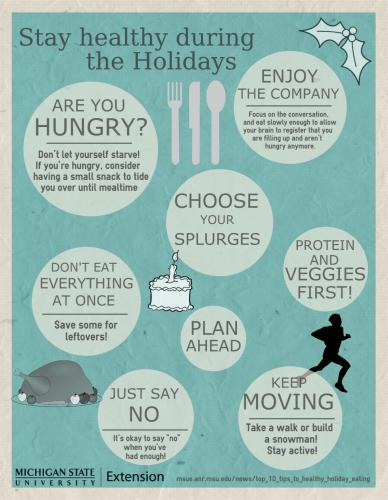
1) Make sure you eat before you go to any holiday gathering. You know you will be tempted by all sorts of unhealthy but yummy foods. Make sure you don’t go overboard by eating something that is good for you before you go. Try to make sure you are not hungry when you arrive, or you will be much more tempted to overeat as well.
2) Drink some water before you go and alternate higher calorie drinks like alcoholic beverages, eggnog or hot chocolate with water while you are at the holiday party. Drinks can have a lot of hidden calories in them, so watch out. Diet sodas are another good option.
3) Fill you plate with some “good “ foods first. Pick some raw vegetables, but go easy on the dip. Turkey breast, and lean ham or pork roast are other good choices. Don’t forget a nice plate of salad with a low fat dressing and some fresh fruit for dessert.
4) Don’t cut your favorite holiday treats completely out. If you don’t allow yourself the occasional small indulgence, you will be much more likely to break down and binge on all those cookies and treats. The key is to enjoy small portions or bites of your favorite foods. If you have a soft side for chocolate chip cookies then go ahead and indulge, but limit yourself to one a day or every few days. Of course the same applies if you prefer cheesecake or gingerbread men.
Eat several small meals a day. This old tip holds especially true during the holiday season. We tend to skip meals and indulge in one large holiday dinner with the entire family. Don’t starve yourself all day. Get some snacks in and most importantly start your day with a good, healthy breakfast. You will be able to enjoy your holiday more by stabilizing your blood sugar. You don't want to spend the day being grumpy from not eating for hours, or be the first ready for a nap after overeating.
5) Use the busy shopping season and burn some extra calories. If you are heading to the mall, park a little further away, or take your time and do a round of window shopping all through the mall before you buy. Every few extra steps that you take count. Just don’t reward yourself afterwards with food. For extra motivation to get more walking in, consider wearing a pedometer. See http://www.walkingofftheweight.com for more information on walking and using a pedometer.
6) Take some time to relax. The holidays can be a very stressful season if we let them. Many of us (including myself) tend to overeat or medicate ourselves with food when we are stressed. Work in some extra time just for you. Sit in front of the fire with a good book or your favorite magazine, go get your nails done, take a bath or go for a walk. Do whatever works for you to calm you down and help you distress.
Above all, enjoy the holidays and remember they are not only about food, but more importantly about family spending quality time together. Treat yourself to some new holiday candles, listen to your favorite Christmas tunes, or go for a drive through a lit up neighborhood this year. Have fun during this special time of the year and enjoy that occasional cookie.
Happy Holidays!
Saturday, August 30, 2014
Tips For Realistically Losing Weight
Reducing calorie intake:
What are calories? A calorie is a unit used to measure energy. It is required by most governments to print the calorie value of foods on the nutrition label of all foods that are sold to consumers. Because if this it is easier to calculate your calorie intake. Reducing calories means not just cutting food intake but being careful of the actual caloric value of the foods you are eating.
Reduction but not eliminating fats and oils: fat and oil is necessary for the body but we often eat foods which are too high in fats thus taking in more fat and oil than we need to. When you cut down fat and oil you will reduce calories and definitely manage to lose those pounds.
Decrease but do not eliminate carbohydrates: Carbohydrates are necessary to the body but we often eat too much of this class of food resulting in the body storing these foods as fat. When you cut down carbohydrates you will reduce your weight.
Increase your protein levels: It is often good to eat foods that are high in proteins as they are not as fattening as other foods. High protein foods are good to eat when you are reducing weight to prevent any muscle loss occurring as you shed those pounds.
Eat more fruits and vegetables: These are good for providing nutrients to the body and are low in calories. They are a good alternative to “junk food” snacks. They will also increase fiber in your diet.
Reduction in sugar and sodium. Sugar is readily broken dawn by the body into energy and excess stored as fat making it a fattening food. Sodium eaten in excess can contribute to water retention by the body and prevent weight loss.
Increasing fiber in your diet: this will help you to curb hunger pangs as fiber rich foods will help you feel full as they take longer to digest. Your digestive system will work better with an increase in fiber.Whole grain foods, unrefined foods, fruits and vegetables will give you more fiber.
Increase your fluid intake: Drink more pure water especially. This will help to improve your health and fill you up.
Increase exercise: Regular exercise will help you reduce weight and build muscle instead of storing fat. You can either work out for about 20 minutes 3 times a week or take a brisk daily walk.
When you use these steps you will reduce your weight. You will not achieve a super figure in one day but when you keep up a healthy diet you will lose weight steadily. Maintaining a healthy diet with regular exercise will ensure that you not only reduce but will keep the weight off. You will feel healthier and have more energy to do the things you really want to do in life.
Tips To Help You Lose Excess Fat

Weight training enhances your fat loss by increasing your muscle mass and more muscle means more calories burned (faster metabolism). It also it gives your skin a more tone, tight appearance, lowers your blood pressure, strengthens your bones, improves your agility, increases your flexibility, strengthens your immune system and gives you more energy and a brighter outlook on life. If you have a high level of body fat, or you have never been able to successfully lose fat, you should consider trying a complete, well-rounded program that not only focuses on dieting, but also includes adequate cardiovascular activity and weight training.
If you are already very muscular, and you just want lose a little body fat, then a fat loss program that includes regular cardiovascular activity and weight training is perfect for you. The best way to get ripped and maintain as much muscle as you can is to diet slowly.
The truth is, when you are on a low calorie diet, your body prefers to use muscle tissue for fuel rather than excess body fat. So, the slower you lose weight, the more likely you are losing fat and not muscle. Ideally, you should aim to lose no more than 1lb - 1.5 lbs per week that's it. If you are obese, then you should try to lose no more than 1% of your bodyweight per week. Any more than that and you are sacrificing muscle.
Women do tend to lose fat at a slower rate than men, but don't let this discourage you. Women simply store fat more efficiently than men because it is needed during and after pregnancy. As your body fat levels drop, you will notice that the fat loss comes off in reverse of how it was put on. So, the most recent fat gains will come off first, while the old fat that has been there for a while will take the longest to lose.
The most difficult fat to lose usually centers around the waist, belly and lower back areas for men, and the upper thigh and buttocks, area for women. The fat in these areas are the most difficult to totally get rid of. This type of fat is difficult to lose because the low blood flow in these areas hinders the fat mobilization. So, if the fat can't be moved into the bloodstream to be used as fuel, those love handles will never go away.
That's why thermogenic supplements help to improve fat loss - they increase circulation into these hard to reach areas and mobilize the stubborn fat.
Remember that you cannot spot reduce!
What I mean by this is that you can't pick and choose the areas that you would like to lose the fat and do exercises that work those areas expecting the fat to just magically disappear in those areas. Your body does not work that way. The only way to decrease the amount of fat in certain key areas is by lowering your total body fat levels.
As you lose fat, it will come off all over your body, not just in specific areas. If you follow a complete diet and weight training program for at least 12 weeks, you will begin to see dramatic changes occurring with your body, and I'm not just talking about the obvious physical changes, I'm also talking about the psychological and physiological changes.
You can expect lower body fat (of course), increased muscle mass, increased metabolism, increased sense of well-being, more energy, lower bad cholesterol level, increased good cholesterol level, decreased risk of heart disease, deeper more restful sleep and most important, increased self-confidence.
To be successful, your fat loss program should include the following:
* A calorie restrictive diet, which requires you to eat no less than 12x and no more than 15x your LEAN bodyweight in calories.
* Regular cardiovascular activity for at least 30-45 minutes 3-4 times per week. Some recommend a moderate pace while other recommend a vigorous pace -- it doesn't really matter as long as you are exercising.
* Weight training.
* Supplementing your diet with vitamins, minerals and amino acids. Vitamin C, L-glutamine, and a good multi vitamin are the bare essentials.
* Adequate dietary fat, including high amounts of Essential Fatty Acids (Omega-6 and Omega-3).
* Regularly monitor your progress. If you don't track your progress you won't know if your diet program is working! Looking in the mirror or just relying on the scale is NOT adequate. Here's a great composition tracking software that I highly recommend http://www.comptracker.com
It will let you know exactly if what you are doing is working.
* Finally, make sure that the program you decide on is compatible with your lifestyle and schedule.
You can have the greatest program in the world, but if you cannot implement it then it is worthless. There are thousands of fat loss diets and workouts that will work, but the hard part is finding one that works for you and the specifics of your diet and schedule restraints.
Thursday, August 28, 2014
Tips to Stick To Your Diet

There's an old Chinese tale about a father and his son who lived on a farm. Together they raised sheep and cared for them. They lived off of these sheep and were able to make money from the sheep's fur. Every day both the father and the son walked around the field where they were raising the sheep to check that the fence was in good order. One night, the fence broke and some wolves sneaked into the field and ate some of the sheep.
The son cried out to his father saying that all was lost and that they were now ruined! But the father simply picked up his tools and took his son to the fence to patch it up. Once the fence had been fixed, the father told his son that just because there was a weakness in the fence it does not mean that it cannot be fixed nor that it is impossible for them to keep raising sheep.
Your diet or exercise regime is like sheep, it is always at risk of violated or destroyed. The fence represents your will power and your circumstances. It might happen that you're too busy to go to the gym or go jogging every morning for a period of time. It might happen that you were forced to stop at a fast food joint on the side of the high way. It might happen that you cave in to eating some chips, some chocolate, or any one of your other cravings. But that doesn't mean you should give up and let your sheep continue to be eaten by wolves. After you've stuffed yourself with what you know to be unhealthy food: stop and think about it. It's not the end of the world.
If you go end up on a binge of food, you don't need to eat more bad food to "get it out of your system", to feel better or to make sure it never happens again. You will be faced with times where you want to eat something unhealthy, or you want to sleep in and skip your step class. No problem, but don't let that one incident ruin your motivation or your commitment to your diet or exercise regime. It happens to everyone, but if you're one of the people who is able to pick yourself up and fix the fence you'll be able to keep losing weight and get healthier.
I hope this story has helped you to understand that not all is lost if your resolve waivers for a day or a week, or what have you. You are the boss of yourself and you can chose to return to eating healthy foods and working out on a regular basis without any fear. Trust in yourself and make sure you keep your eyes focused on the goal since that's what keeps us all motivated.
Tools For Your Weight Loss Arsenal
Tools are something we use to help us get a job done more easily. A good weight loss tool is one that encourages a healthy lifestyle and permanent weight loss.
•Home exercise equipment is a fantastic way to speed up your weight loss results and feel great!
•Home exercise equipment and be used in conjunction with your healthy weight loss plan.
•Losing weight is simply a matter of burning more calories than you consume - home exercise equipment is a great way to increase the amount of calories you burn while improving your overall health and fitness.
•A quality piece of home exercise will give you years of satisfaction and enjoyment.
•Busy lifestyles increase the need for home fitness equipment by allowing you to exercise on your schedule.
Here are some ideas to help you narrow down your choices and find the right piece of equipment for your particular needs.
•What type of equipment do you have room for?
•Are you interested more in cardiovascular exercise or resistance exercise?
•Choose a quality exercise machine from a reputable dealer and remember that purchasing online is a great way to save money.
•Online home exercise equipment dealers will assist you in finding the right piece of equipment for your specific needs.
•You will not be satisfied with a low quality piece of exercise equipment! Your body is too important to risk injury with a poorly designed piece of equipment.
Choose your exercise equipment wisely and you will enjoy improved health and ideal weight for years to come! Remember - It is much easier to make exercise a part of your daily ritual when you have exercise equipment in your home. You can always fit exercise into your schedule when you have the right equipment!
Turning Off The Fat Genes
Genes do influence our size and shape, but studies clearly show that if you change your diet and lifestyle, you can override hereditary effects to a great degree. Contrary to popular understanding, genes are not dictators, they are committees. They do not give orders; they make suggestions. You can counteract your fat genes and boost your thin genes.
We often think of genes as unchangeable because, when it comes to eye color or hair color, they really are decisive. If they call for blue eyes or brown hair, that's it. But the genes that establish your size and shape are much more flexible. They need to be able to adjust your appetite and your calorie burning, depending on whether food is plentiful or not, and whether you are working hard or resting. Unlike eye or hair color, your body has to be able to change its composition from minute to minute, from day to day.
Although your chromosomes are extraordinarily complex, there are just five key gene groups you need to know about:
* Taste genes determine the foods you crave. In taste experiments, scientists use a test substance called PROP (6-N-propylthiouracil). About one in four people can taste its bitterness very strongly. These people avoid grapefruits and never go near black coffee. Although their acute taste sense is generally an advantage, the downside is they may avoid healthy vegetables, such as broccoli or cabbage, that have a hint of bitterness. If this group includes you, you'll want to find ways to flavor these healthy vegetables so you will include them in your routine.
Another one in four people cannot taste PROP and are called "taste blind." Their problem is they may tend to overeat, making up in quantity what they are missing in taste. If this includes you, and you tend to be indiscriminate in what you're eating, you'll want to take care to emphasize fruits, vegetables, whole grains, and beans, and to be very cautious about fatty foods and their hidden calories.
* A gene on chromosome 7 makes leptin, the appetite-taming hormone. In 1997, English researchers reported the case of two cousins who became extremely obese very early in life. They demanded food continuously and ate much more than their siblings. At age 8, one weighed 189 pounds. She had so much trouble walking she had to have liposuction of her legs. Her cousin was only two years old but already weighed 64 pounds. It turned out they shared a rare mutation blocking the leptin gene. With no leptin to curb hunger, their appetites were voracious.
You are not likely to have this same gene abnormality. However, your leptin may not be working perfectly either. Very-low-calorie diets disrupt its appetite-taming effect, causing your appetite to run out of control. The key to keeping leptin working right is to avoid severe calorie restrictions. If you eat at least 10 calories per day per pound of your ideal weight, you are unlikely to run into serious problems.
* A gene on chromosome 8 builds LPL, the key enzyme that stores fat in your cells. It waits along the walls of the tiny blood vessels that course through your body fat, and its job is to extract fat from your bloodstream and pass it into your fat cells for storage. If your LPL is doing its job a little too well, you can change this genetic tendency by choosing foods that have little or no fat in them. Once again, vegetables, fruits, legumes, and whole grains are your best friends.
* The hormone insulin, coded on chromosome 11, is part of your body's system for increasing your metabolism after meals. Depending on the type of foods you choose, you can help insulin spark a pronounced after-meal burn that releases calories as body heat rather than storing them as fat. Low-fat, vegan diets, along with regular exercise, make insulin more efficient.
* Believe it or not, exercise aptitude is largely biological, too. People who love to go for a five-mile run at the crack of dawn are genetically different from other people. They are endowed with a better capillary network that brings oxygen to working muscles and a more efficient fuel-burning mechanism. If you did not get these genetic advantages, you can do the next best thing. If you begin a regular exercise program and stick with it, your muscle cells begin to look more and more like those of natural athletes.
There is no need to be daunted by your family heritage. Yes, some of us will always be bigger and others smaller. But with a healthy, low-fat diet and regular physical activity, your genes can stop working against you and start working for you.
Understand How To Lose Weight!
Carbohydrate is one of the three macronutrients, the other two being protein and fat. Carbohydrates provide essential energy for the brain, red blood cells and a growing fetus. Carbohydrate is also the principal fuel source for strenuous muscular activity. The carb food group includes many foods that are packed with vitamins, minerals and phytochemicals (disease-protective plant chemicals). A healthy diet must include carbohydrates.
The brain's favorite fuel is carbohydrate. If absolutely necessary, the brain will utilize fat (in the form of ketones), but it performs less efficiently on this type of energy. Current evidence demonstrates a clear association between intellectual performance and the presence of carbs. For example, better performance was observed in all types of age and social groups after a carbohydrate meal. Although research is ongoing, it seems that for optimum intellectual activity, we need a regular intake of carbs.
In terms of chemical structure, the two main types are Simple Carbohydrate (or "simple sugars"), like Monosaccharides and Disaccharides; and Complex Carbohydrates (or "complex sugars"), like Oligosaccharides and Polysaccharides. Carbohydrate comes mainly from plant-food, such as vegetables, fruits, beans, and cereal grains, although the simple sugar lactose is found in milk and milk products.
Simple carbs include: glucose, fructose and lactose. Common sources include table sugar (sucrose), boiled sweets, syrups and honey.
Complex carbs comprise starches or fiber. Good sources of starches include, bread, pasta, rice, beans and some vegetables. Good sources of dietary fiber include: vegetables, fruits, beans, along with the indigestible part of the grain, like wheat bran and oatbran.
Our food fuel comprises the protein, carbohydrate, fat and alcohol we eat. But the exact mixture our body uses typically varies according to circumstances (eg. our physical activity, our last meal etc.). There is an "order of priority" that dictates which fuels are burned first. Alcohol calories are burned first. This is because we cannot store alcohol energy. Next, we burn protein, then carbohydrates, then fat. In practice, however, we typically burn a "mixture" of carbs and fat, with the ratio being dependent on meals. Just after meals we burn mainly carbohydrate, while between meals we burn more fat.
Understanding obesity - how to reduce weight
If you eat more nutrients containing energy than you need for your daily activities, for the internal processes of your body, and for the burning process that maintains the body temperature, the excessive nutrients can be transformed to fat and stored in the fat depots in your body. The causes of this occururing, and thus of overweight, are one or more of these factors:
1. Consuming too much fat: Fat is the most energy-rich nutrient, and over-consume will cause the eccessive fat consumed to be deposited in the body.
2. Consuming too much sugar, starch or other carbohydrates: Carbohydrats are also important energy sources. Over-consume of carbohydrates will cause the eccess to be converted to fat and stored in the body.
3 Consuming too much alchohol: Also this substance contains energy, and eccessive consume results in fat stored in your body.
4 Consuming too much of preprocessed products with added, and often hidden fat or sugar, like sweet beverages, cakes, ice-cream, fast food and snacks.
5. Eating too much alltogeather: Perhaps your food is not fat- or sugar-laden, but you simply eat too much alltogeather. Also protein will be converted to fat if it is overconsumed.
6. Irregular eating, like eating much at one time, little at another time, wait long between some meals, cunsuming huge doses of sugar at some times, no sugar at other times: If you eat irregularly, you can get an uncontrollable appetite, a swinging blood sugar level, and an abnormal physiology that makes you deposit fat in your body.
7. A still sitting life with little exercise so that you burn little fat and sugar.
8. Boredom in your daily life: If you do not have much hobbies, or leasure activities, or isolate yourself from other people, you may suffer form boredom, and eccessive eating may be your way of getting entertainment.
9. The body has some capacity of burning some extra amount of sugar or fat. This capacity may be decreased because of lack of vitamins and minerals, and because of an unsound diet.
10. An abnormal appetite that urges you to eat far more than you need: This abnormal appetite may originate from psychological causes, an onsound diet or lack of exercise.
AANALYZE YOUR OBESITY PROBLEMS
Before beginning your weight reduction program, go through every possible obesity causing factor listed above, to find out what factors contribute to your over-weight problem. Go down to details. For example: If you find you consume too much sugar, find out the exact food types contributing to your eccessive sugar consume. Write everything down.
MAKE A PLAN
With the performed analysis in hand, make a plan for your weigh reduction. Decide a goal for your weight. Decide one or more measures for each component contributing to your problem. Write down your plan.
HOW TO REDUCE WEIGHT
In order to successfully loose weight, you must attack every component you have found to be a causing factor of your obesity problem. Here are the concrete mesures you can use, and put into your plan:
1. Eat less fat
If you eat much fat, you must reduce the daily intake of fat, to do so:
* Choose fat poor fish, fat poor meat/beef, chicken, turkey, mushrooms and other food sources with law fat content as the main components for dishes.
* Cut away visible fat from meat or other food sources.
* Do not add much margarine, butter or oil to your food.
* When you fry something, try to use as little fatty smear in the pan as possible.
2. Eat less sugar
If you eat much sugar, reduce your daily inntake of free sugar, or bounded sugar as in flour, potatoes and the like:
* Do not add much sugar to your food.
* You may also need to consume less bread, potatoes, peas and beens, if you eat very much of it, but do not stop eating these kinds of food, since they contain valuable nutrients. However, use bread made of full corn.
3. Avoid eccessive alcohol consume
Alcohol contains energy, and will be transformed to fat, if you consume too much of it.
4. Avoid preprocessed food with added and often hidden fat or sugar
Some food contains a great amount of hidden fat or sugar, espesially fast food, snacks or preprocessed food.
* Therefore you should avoid eating much of products like: cakes, sweet drinks, snacks, choclate, icecream or fast-food.
* You should also buy all the food you use in a natural form, and make your dishes yourself. Then you achieve an absolute controle over the amount of fat and suger in your dishes
5. Eat less alltogeather, but do not starve yourself
Having reduced the amount of sugar and fat from your diet, you may fall to the temptation of eating more than before, beacuse the new composition of your food does not satisfy your hunger. You should be aware of, and avoid this trap.
* When trying to loose weight, you should reduce the total amount of the food you eat.
* However, you should not starve yourself. To starve will only make you tired and sick, and then make you interrupt your efforts to get slim.
6. Eat regularly
Regular eating habits will give you a stable blood sugar level, help you control your appetite and normalize your fat burning physiology.
* You should eat three or four meals each day.
* Each meal should contain the same moderate amount of sugar and fat.
* Each meal should contain some protein sources like fish, meat, eggs, mushrooms or proteine-rich seeds, and in every means be as nutritionally complete as possible.
7. Increase your daily physical activity
Physical activity increases fat burning and will help you control your appetite.
* Do some daily exercises of a kind that increases energy consumption: Jogging, cycling, swimming, ball play, skiing, and so on.
* Do also som exercises to increase your muscular volume, since muscles will burn fat, for example weight lifting.
8. Find some new hobby or interest
If you find yourself some new hobby or leasure activity, you will avoid boredom and the temptation to over-eat because you are bored. Try also to do interesting activities together with other people. The new activities will also give you less time to only sit eating.
9. Eat healthy food to increase your fat burning capacity
It is not possible to loose weight without sticking to the above mentioned basic fat reduction principles, but you will also benefit from applying some measures that will increase your ability to passivly burn fat:
* Eat as natural food as possible, avoid food that has been heavily cooked, heavily fried or chemically processed. Natural food has its content of protein, vitamines minerals and anti-oxydants intact, and these are necessary for the fat burning abilities.
* Eat some raw fruit and vegatables to each meal, since these contain vitamins, minerals and anti-oxydants you need.
* You may benefit from supplements of vitamins, minerals, herbs, anti-oxydants, as these will make your body more capable of burning fat.
* The little fat you use in your diet, should come from sources like olive, peanuts, canola, fish, nuts, sun-flower, etc. Then you will get a good balance between mono-unsaturated fat (olive, canola, peanuts), poly-unsaturated fat of the omaga-3-type (fish) and poly-unsaturated fat of the omega-6-type (sunflower).
* Consume whole cereals or bread made from whole unrefined cereals.
* There are also natural products on the market you can use to increase your break down and burning of fat.
10. Bring your appetite under controle
Many of the measures allready listed, will also help you to controle your appetite. If this still is difficult, this problem may be attacked by specific means:
* You can use some medicines to reduce appetite for some time or to reduce the uptake of fat or carbohydrates in your inestines. There are both natural medicines based on herbs, vitamins and minerals and pharmachological products to achieve this.
* Daily meditation can help to relaxe your mind and gain controle.
* Psychological counseling may be necessary.
11. The ratio between fat and sugar in your diet
The total mount of fat and carbohydrates combined, is a key factor in causing obesity, not fat alone or carbohydrates alone. In some weight loosing regimes, one eats very little carbohydrates, and fairly much fat. In others one eats fairly much carbohydrates, and very little fat. The proponents of each type of regime claim that their approach helps the body to burn fat better.
Probably people are different, and react differently when trying to manipulate the diet in these ways. As a first approach, it is probably not wise to try such extreme approaches. However, if you have brought your eating habits under controle, and still not achieved a satisfactory result, you can try to manipulate the fat/carbohydrate ratio to see if this will help. But do not stop consuming fat alltogeather. You will allways need some essential fatty acids in your diet.
CARRYING OUT YOUR PLAN
Having made your plan for your weight reduction, the time has come to carry it out. After each week, go through the points in your plan, and evaluate how well you did. Also check your weight. Write down for every point in your plan how well you did.
Understanding the Tummy tuck procedure and Complications from Tummy tuck surgery
If you are worried or concerned about complications associated with the tummy tuck procedure, talking to a qualified plastic surgeon that has been trained in body contouring should help alleviate many concerns you may have.
Finding a good experienced plastic surgeon should not be difficult as plastic surgery is practiced abundantly in most major cities.
It should be noted that with advancements and technology in plastic surgery, most complications following tummy tuck surgery are deemed rare.
Educating yourself about the tummy tuck procedure should be your first step in helping you choose a plastic surgeon. A good qualified plastic surgeon will take time to discuss with you procedures in place to minimize complications from tummy tuck surgery.
Ask your plastic surgeon lots of questions about the tummy tuck procedure and any complications that could develop following your tummy tuck surgery. Being well informed is the best choice you can do for yourself and should help alleviate most concerns you may have.
Listed below are some of the complications associated with the tummy tuck procedure that should be addressed with your plastic surgeon.
Allergic reaction - to the anesthesia
Infection - can be a serious problem and if bleeding occurs may develop into a hematoma
Hematoma - A collection of blood under the skin (commonly referred to a blood blister)
Blood clots - More common with women taking birth control pills.
Fat necrosis - After the abdominal wall has been stretched. Blood supply to the remaining fat and skin has been damaged. On rare occasions this may lead to necrosis of the fat cells which then become liquefied and hardened.
Swelling - Mostly lasts for a month a month to six weeks following surgery.
Bruising - Common in the abdomen area but in severe cases can extend to the surrounding skin.
Skin Loss - The abdominal wall is stretched during surgery and blood supply to the skin may be damaged which may result in death of the skin in the surrounding areas. This is more common in people with diabetes and smokers. If this occurs a skin graft may be needed.
Wound Separation - Scar tissue heals slowly and some separation may be expected, although rarely a problem it may lead to a heavier scar and slower recovery.
Some common plastic surgery techniques being utilized today to reduce complications in certain areas following your tummy tuck surgery are as follows.
Pain and nausea can be greatly reduced if your plastic surgeon injects and long lasting numbing medicine in the rectus muscle which has been tightened during the tummy tuck procedure. This is a simple procedure if performed by your plastic surgeon will most likely reduce complications from pain and expedite your recovery from plastic surgery.
Applying a topical steroid cream for a few days following surgery will significantly reduce complications from scarring, and if followed up for about six weeks your scars will fade faster and become much less noticeable.
Fluid collection under the skin following your tummy tuck surgery can be reduced by placing drains under the skin at the time surgery is performed.
Another procedure you may ask your plastic surgeon about for reducing the complications of fluid collection is by placing internal stitches between the fascia (gristle) and the underside of your fat. Most likely this will prevent any complications from fluid collection before they start.
This tummy tuck procedure may reduce the time of having your drains in place to just 2-3 days following your tummy tuck surgery
Becoming educated in the tummy tuck procedure is your responsibility and should not be avoided. Only then will you be able to make wise choice finding a qualified plastic surgeon that you will be confident with to perform your tummy tuck surgery.
After carefully choosing your plastic surgeon you will then be able to understand the procedures in place to reduce any risk of complications.
Dennis M. Driscoll
Understanding your Metabolism

When we diet, by decreasing our calorie intake too drastically, we cause our metabolism to slow down, making it progressively more difficult for us to lose weight. Most diets fail, yet we continue to try one after another, always hoping that each new regime will provide the ‘magic’ solution. If this sounds like your problem, there may be a simple answer. Let’s look at why most diets fail, and how strength training, combined with a healthy food intake can speed up your metabolism, making it easy for you to lose weight.
By drastically cutting our food intake, our body’s natural instinct is to switch to a ‘starvation response.' The fewer calories we consume, the more our bodies become efficient at using these calories - leading to slower weight loss. This was once a useful mechanism for our ancestors when food supplies were less predictable, but this ’vicious circle’ can make life almost impossible for the modern dieter.
When the body is persistently kept short of calories, it breaks down muscle tissue to use as fuel. Our body, using water from our tissue cells, quickly washes this away causing an instant reduction in weight through water loss. However, this weight loss will be short lived, and will quickly be regained when we take in water and the muscle we have lost will slow down our metabolism in the long term.
The reason for this is that each pound of muscle requires a certain number of calories each day just to maintain it. Therefore, the more muscle you have, the more calories you burn even when you’re doing nothing, even sleeping! If you lose muscle, then your daily calorie requirement becomes less. For example, imagine a dieter loses 10 pounds of muscle (along with maybe 20 lbs. of fat) on a strict diet. Now suppose that each pound of muscle had been burning 50 calories a day. Together, those 10 pounds of muscle had been burning 500 calories a day. With this muscle tissue gone, the dieter must now consume 500 less calories a day in order to maintain that weight-loss!
However, of course people do not stick to their diets for ever and when they return to their old eating habits, the weight that they have lost, invariably comes piling back on. Unfortunately, whilst they lost both muscle and fat during the diet, all the weight they regained was fat. So, even though they may weigh the same as they did when they started, they now have a lot more fat and a lot less muscle than they did before the diet. Therefore, their metabolism is slower and their calorie requirements are less. Even if they return to their pre-diet eating habits, they still require 500 fewer calories a day due to the muscle loss. That’s one reason dieters are prone to regaining all of the lost weight, and conversely sometimes even gain weight afterwards.
A good solution is an active lifestyle that includes aerobic exercise, a good weight-training program, and a healthy diet containing fresh fruits and vegetables, whole grain cereals and plenty of lean protein. It is a good idea to eat ‘little and often’ – keeping your metabolism in high gear by eating 4 to 6 small meals a day, rather than one or two larger ones. No food is forbidden, but sweets and high fat junk food are eaten less often, and in smaller quantities. A healthy diet is a realistic and permanent way of eating – not a diet that you suffer through for a week or two and then give up!
The goal is to consume as many calories as you can, while still losing body fat and maintaining or adding lean muscle at the same time. If your calories are already below normal, don’t restrict them further. Instead, maintain your current amount and instead try to become stronger and more active, so you can gradually increase your calories to a normal healthy level. If your calorie intake is already in a healthy range, decrease it only slightly, if necessary. A small reduction of about 250 calories a day, or 10-15 percent less than usual, is more likely to protect your lean muscle, and less likely to trigger a go-slow in your metabolism.
If you follow this type of routine, it’s possible to gain about one pound of muscle per week and lose about one pound of fat per week. The end result is that the number on the scale might not move much at all, it may even go up. Your clothes will feel looser, and you’ll feel great. Yet the numbers on the scale won't move!! It's at this point that a lot of people give up the weight training because they don't understand what's happening.
The truth is that when you're strength training it's possible to get smaller and heavier at the same time, as muscle is a much denser tissue than fat. The fat takes up more space on your body. At this point, it's best to ignore the bathroom scales and rely on the way you look and the way your clothes fit.
The conventional way of dieting can lead to a weak, tired body, exhausted by the constant cycle of starvation and weight gain, unable to enjoy food. However, by following these easy steps above, you can easily reach your goal - the slim, strong, healthy body of a naturally lean person who can enjoy their food without guilt, for life!
Subscribe to:
Comments (Atom)